
BetterThisWorld Money vs The Motley Fool


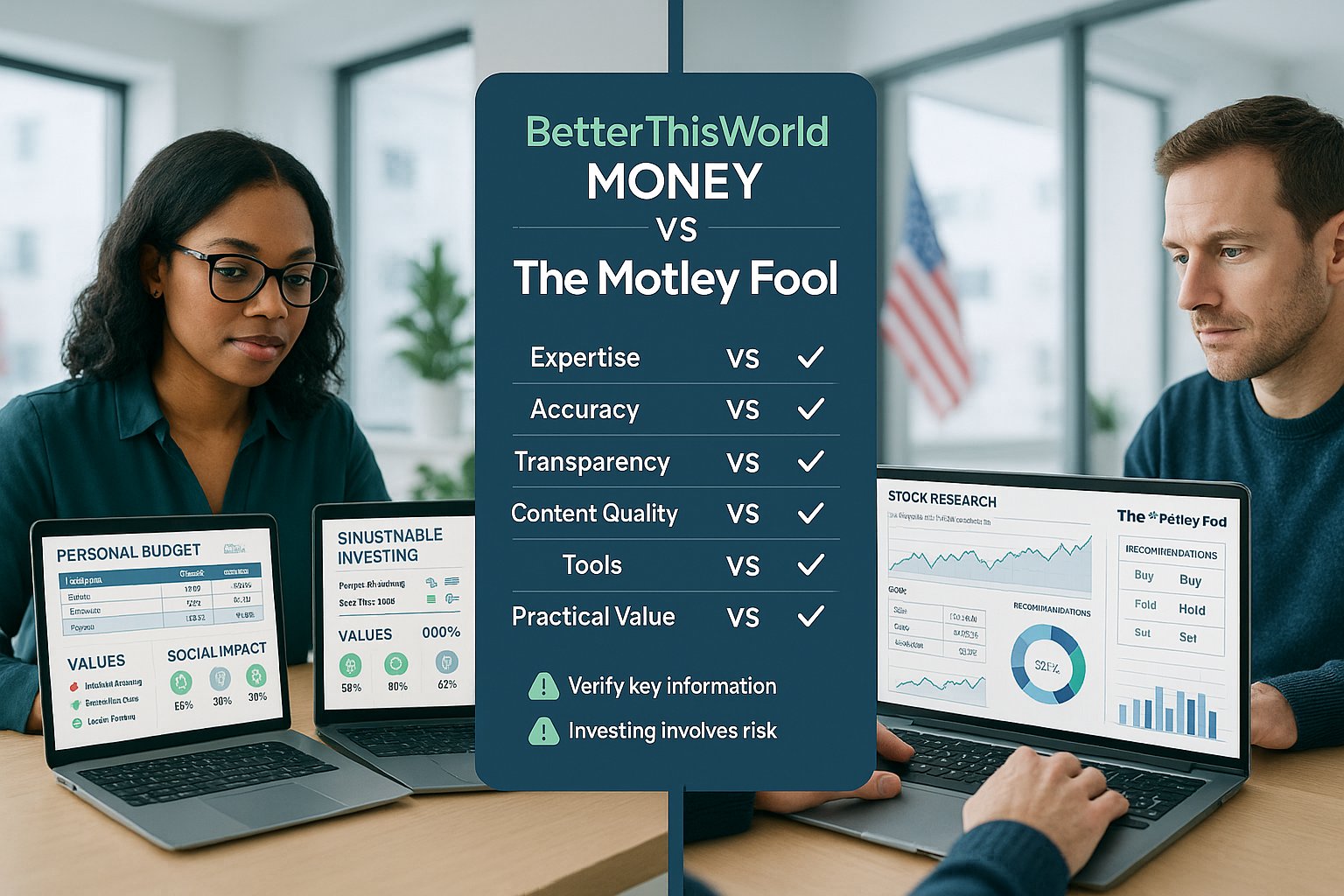
BetterThisWorld Money vs The Motley Fool is not a conventional head-to-head contest. The Motley Fool is an established investment publisher with paid stock-picking services. BetterThisWorld Money appears primarily connected to educational content about using money for personal and social impact: reliable public evidence does not establish an equivalent research service.
This 2026 review compares both names using verifiable criteria: expertise, accuracy, transparency, content quality, tools, and practical value. It does not treat marketing claims as proven results. Readers should view the comparison as a guide to documented usefulness, not a promise that either source will improve investment returns.
Key Takeaways
- The Motley Fool provides verified stock research and recurring recommendations suited for self-directed investors seeking actionable investment ideas.
- BetterThisWorld Money focuses on connecting financial decisions with social and environmental impact but lacks verified stock-picking services or documented performance.
- The Motley Fool’s content offers clear investment theses and educational resources, making it more practical for those learning stock analysis or seeking curated stock ideas.
- BetterThisWorld Money is better aligned with readers interested in purposeful spending and values-driven finance rather than direct investment advice.
- Neither platform replaces personalized financial advice; investors should independently verify claims and consider their own risk tolerance when using these resources.
- Overall, The Motley Fool is recommended for investment research, while BetterThisWorld Money serves readers exploring the broader purpose of money and social impact.
BetterThisWorld Money and The Motley Fool at a Glance
The first major difference is scope. The Motley Fool publishes market commentary, investor education, retirement guidance, and individual stock recommendations. Its best-known subscription, Stock Advisor, provides recurring picks and supporting analysis for investors who accept the risks of owning individual companies.
BetterThisWorld Money has a less clearly documented role. The available site material focuses on how people can use cash, personal finance, and investment choices to create positive outcomes. The core BetterThisWorld Money concept hence looks more like an editorial framework than a verified counterpart to Stock Advisor.
| Criterion | BetterThisWorld Money | The Motley Fool |
|---|---|---|
| Primary focus | Money and impact-oriented content | Investing content and stock research |
| Paid stock service | Not verified | Stock Advisor and other subscriptions |
| Published track record | Not verified | Self-reported recommendation performance |
| Likely reader | General money reader | Self-directed stock investor |
The broader money and impact approach may suit values-led readers. The Motley Fool suits readers seeking named stock ideas.
Evaluation Criteria: Expertise, Accuracy, Transparency, and Practical Value
Verifiable evidence gives The Motley Fool a clear advantage in institutional history, but history alone does not guarantee accurate picks. The company identifies analysts, explains investment theses, and maintains an extensive archive of investing material. Its long-term performance figures are self-reported and depend on methodology, timing, and whether an investor followed every recommendation.
The BetterThisWorld Money vs The Motley Fool evaluation uses four tests:
- Expertise: Are authors, analysts, and qualifications identifiable?
- Accuracy: Can claims be checked against dates, sources, and defined benchmarks?
- Transparency: Are prices, risks, conflicts, and limitations visible?
- Practical value: Can a reader act without guessing what the advice means?
Readers can compare unfamiliar terms with independent investing education. They can also assess whether advice supports sustainable investments or simply uses ethical language without measurable standards.
BetterThisWorld Money lacks enough public evidence to score confidently on authorship, performance, or formal research controls. That uncertainty is material, not a minor omission.
Content Quality, Topics, and Reader Experience
The Motley Fool turns complex company stories into readable investment cases. A typical article explains what a business sells, why revenue might grow, and which risks could break the thesis. This format helps beginners, although short market articles can feel promotional when they lead readers toward premium services.
Its editorial range includes stocks, exchange-traded funds, retirement, and market news. The main Motley Fool investing site also publishes free material, so readers can test its style before paying. Clear language is a strength. Repeated upgrade prompts are a potential distraction.
BetterThisWorld Money appears better aligned with broad questions such as responsible spending, financial purpose, and social impact. Related coverage of using finances constructively can help a reader connect a budget with personal values. But, that content should not be mistaken for audited securities research.
In the BetterThisWorld Money vs The Motley Fool reader experience, one platform explores how money can serve goals: the other evaluates investments and sells recommendations. The better experience depends on the question being asked.
Investment Research, Tools, and Paid Services
The sharpest gap appears in paid research. The Motley Fool operates subscription services, including Stock Advisor, that deliver recurring recommendations and analysis. Subscription names, offers, and renewal terms can change, so a buyer should verify the current checkout page rather than rely on an old review.
A stock pick is not a complete portfolio. Investors still need to evaluate valuation, diversification, taxes, time horizon, and loss tolerance. A recommendation may fall sharply before an investment thesis succeeds, or fail permanently. That is the uncomfortable part of stock picking that glossy return charts can hide.
No equivalent BetterThisWorld Money subscription, screening tool, model portfolio, or documented recommendation history can be confirmed from the supplied evidence. Articles discussing BetterThisWorld stocks may provide context, but readers should verify whether any named entity is a regulated business, an editorial label, or a general concept before sending money.
Independent consumer money guides can help with banking and credit questions. They do not replace a registered financial professional or individualized investment advice.
Strengths and Weaknesses of Each Platform
The Motley Fool offers the stronger documented product, while BetterThisWorld Money offers a broader values-based lens. Neither approach covers every financial need.
BetterThisWorld Money
Strengths
- Connects financial choices with social or environmental goals.
- Uses accessible themes that general readers can understand.
- Encourages readers to consider the purpose behind spending and investing.
Weaknesses
- Provides insufficient verified information about formal research methods.
- Shows no confirmed equivalent to a recurring stock-pick subscription.
- Lacks a substantiated performance record for direct comparison.
Related material about social-impact companies can expand the discussion, but readers must separate educational content from investment due diligence.
The Motley Fool
Strengths
- Has recognizable analysts, established publishing operations, and extensive archives.
- Explains long-term investment theses in approachable language.
- Offers specific recommendations rather than vague market commentary.
Weaknesses
- Charges for its core recommendation services.
- Reports its own headline performance figures.
- Exposes subscribers to concentration, volatility, and stock-selection risk.
- Receives mixed customer feedback about marketing, expectations, and subscriptions.
That balance prevents the BetterThisWorld Money vs The Motley Fool review from becoming a simple popularity contest.
Which Platform Is Better for Different Readers?
The Motley Fool is more useful for a self-directed investor who wants recurring company ideas and can independently judge risk. BetterThisWorld Money is potentially more relevant to a reader exploring how financial decisions relate to values and impact.
| Reader | More suitable option | Reason |
|---|---|---|
| Beginner learning stock analysis | The Motley Fool | It provides structured theses and investor education. |
| Busy long-term stock picker | The Motley Fool | Curated ideas narrow the research list. |
| Reader focused on purposeful money use | BetterThisWorld Money | Its editorial framing emphasizes impact. |
| Investor requiring verified performance | The Motley Fool, with caution | More evidence exists, but figures remain self-reported. |
| Person seeking personal advice | Neither | General publishing cannot assess individual circumstances. |
Readers researching personal finance strategies should confirm claims through company filings and regulatory sources. They should never buy a stock solely because an article presents an exciting story.
In practical terms, BetterThisWorld Money vs The Motley Fool compares two different jobs: defining what money should accomplish and researching which stocks might deliver returns.
Readers who need more context on the former platform can review the BetterThisWorld.com Money overview before comparing its role with dedicated investment-research services.
Final Verdict and Recommendation
The Motley Fool is the more useful and verifiable choice for readers who specifically want stock research, recurring recommendations, and long-term investing education. Its paid services still require careful review because self-reported results do not ensure future returns.
BetterThisWorld Money may help readers examine purposeful financial choices, but evidence does not support treating it as an equivalent stock-research platform. The final BetterThisWorld Money vs The Motley Fool verdict hence favors The Motley Fool for investment research, and reserves judgment on any unsupported comparison of performance, tools, or paid services.


BetterThisWorld Money Explained for Beginners

BetterThisWorld Money Explained for Beginners

Building Wealth with BetterThisWorld Money Resources

Building Wealth with BetterThisWorld Money Resources

BetterThisWorld Money Features Explained

Cambridge Businesses Push Back Against Rising Municipal Fee Structures

Midland residents turning to digital payment tools for everyday spending

Why Landlords Are More Successful With Good Tenant Relationships

Everyday Product Swaps for a More Natural Lifestyle

Easy Ways to Create a Designer Living Room Without Overspending
BetterThisWorld Money vs The Motley Fool
BetterThisWorld Money vs The Motley Fool is not a conventional head-to-head contest. The Motley Fool is an established investment publisher with paid stock-picking services. BetterThisWorld Money appears primarily connected to educational content about using money for personal and social impact: reliable public evidence does not establish an equivalent research service.
This 2026 review compares both names using verifiable criteria: expertise, accuracy, transparency, content quality, tools, and practical value. It does not treat marketing claims as proven results. Readers should view the comparison as a guide to documented usefulness, not a promise that either source will improve investment returns.
Key Takeaways
- The Motley Fool provides verified stock research and recurring recommendations suited for self-directed investors seeking actionable investment ideas.
- BetterThisWorld Money focuses on connecting financial decisions with social and environmental impact but lacks verified stock-picking services or documented performance.
- The Motley Fool’s content offers clear investment theses and educational resources, making it more practical for those learning stock analysis or seeking curated stock ideas.
- BetterThisWorld Money is better aligned with readers interested in purposeful spending and values-driven finance rather than direct investment advice.
- Neither platform replaces personalized financial advice; investors should independently verify claims and consider their own risk tolerance when using these resources.
- Overall, The Motley Fool is recommended for investment research, while BetterThisWorld Money serves readers exploring the broader purpose of money and social impact.
BetterThisWorld Money and The Motley Fool at a Glance
The first major difference is scope. The Motley Fool publishes market commentary, investor education, retirement guidance, and individual stock recommendations. Its best-known subscription, Stock Advisor, provides recurring picks and supporting analysis for investors who accept the risks of owning individual companies.
BetterThisWorld Money has a less clearly documented role. The available site material focuses on how people can use cash, personal finance, and investment choices to create positive outcomes. The core BetterThisWorld Money concept hence looks more like an editorial framework than a verified counterpart to Stock Advisor.
| Criterion | BetterThisWorld Money | The Motley Fool |
|---|---|---|
| Primary focus | Money and impact-oriented content | Investing content and stock research |
| Paid stock service | Not verified | Stock Advisor and other subscriptions |
| Published track record | Not verified | Self-reported recommendation performance |
| Likely reader | General money reader | Self-directed stock investor |
The broader money and impact approach may suit values-led readers. The Motley Fool suits readers seeking named stock ideas.
Evaluation Criteria: Expertise, Accuracy, Transparency, and Practical Value
Verifiable evidence gives The Motley Fool a clear advantage in institutional history, but history alone does not guarantee accurate picks. The company identifies analysts, explains investment theses, and maintains an extensive archive of investing material. Its long-term performance figures are self-reported and depend on methodology, timing, and whether an investor followed every recommendation.
The BetterThisWorld Money vs The Motley Fool evaluation uses four tests:
- Expertise: Are authors, analysts, and qualifications identifiable?
- Accuracy: Can claims be checked against dates, sources, and defined benchmarks?
- Transparency: Are prices, risks, conflicts, and limitations visible?
- Practical value: Can a reader act without guessing what the advice means?
Readers can compare unfamiliar terms with independent investing education. They can also assess whether advice supports sustainable investments or simply uses ethical language without measurable standards.
BetterThisWorld Money lacks enough public evidence to score confidently on authorship, performance, or formal research controls. That uncertainty is material, not a minor omission.
Content Quality, Topics, and Reader Experience
The Motley Fool turns complex company stories into readable investment cases. A typical article explains what a business sells, why revenue might grow, and which risks could break the thesis. This format helps beginners, although short market articles can feel promotional when they lead readers toward premium services.
Its editorial range includes stocks, exchange-traded funds, retirement, and market news. The main Motley Fool investing site also publishes free material, so readers can test its style before paying. Clear language is a strength. Repeated upgrade prompts are a potential distraction.
BetterThisWorld Money appears better aligned with broad questions such as responsible spending, financial purpose, and social impact. Related coverage of using finances constructively can help a reader connect a budget with personal values. But, that content should not be mistaken for audited securities research.
In the BetterThisWorld Money vs The Motley Fool reader experience, one platform explores how money can serve goals: the other evaluates investments and sells recommendations. The better experience depends on the question being asked.
Investment Research, Tools, and Paid Services
The sharpest gap appears in paid research. The Motley Fool operates subscription services, including Stock Advisor, that deliver recurring recommendations and analysis. Subscription names, offers, and renewal terms can change, so a buyer should verify the current checkout page rather than rely on an old review.
A stock pick is not a complete portfolio. Investors still need to evaluate valuation, diversification, taxes, time horizon, and loss tolerance. A recommendation may fall sharply before an investment thesis succeeds, or fail permanently. That is the uncomfortable part of stock picking that glossy return charts can hide.
No equivalent BetterThisWorld Money subscription, screening tool, model portfolio, or documented recommendation history can be confirmed from the supplied evidence. Articles discussing BetterThisWorld stocks may provide context, but readers should verify whether any named entity is a regulated business, an editorial label, or a general concept before sending money.
Independent consumer money guides can help with banking and credit questions. They do not replace a registered financial professional or individualized investment advice.
Strengths and Weaknesses of Each Platform
The Motley Fool offers the stronger documented product, while BetterThisWorld Money offers a broader values-based lens. Neither approach covers every financial need.
BetterThisWorld Money
Strengths
- Connects financial choices with social or environmental goals.
- Uses accessible themes that general readers can understand.
- Encourages readers to consider the purpose behind spending and investing.
Weaknesses
- Provides insufficient verified information about formal research methods.
- Shows no confirmed equivalent to a recurring stock-pick subscription.
- Lacks a substantiated performance record for direct comparison.
Related material about social-impact companies can expand the discussion, but readers must separate educational content from investment due diligence.
The Motley Fool
Strengths
- Has recognizable analysts, established publishing operations, and extensive archives.
- Explains long-term investment theses in approachable language.
- Offers specific recommendations rather than vague market commentary.
Weaknesses
- Charges for its core recommendation services.
- Reports its own headline performance figures.
- Exposes subscribers to concentration, volatility, and stock-selection risk.
- Receives mixed customer feedback about marketing, expectations, and subscriptions.
That balance prevents the BetterThisWorld Money vs The Motley Fool review from becoming a simple popularity contest.
Which Platform Is Better for Different Readers?
The Motley Fool is more useful for a self-directed investor who wants recurring company ideas and can independently judge risk. BetterThisWorld Money is potentially more relevant to a reader exploring how financial decisions relate to values and impact.
| Reader | More suitable option | Reason |
|---|---|---|
| Beginner learning stock analysis | The Motley Fool | It provides structured theses and investor education. |
| Busy long-term stock picker | The Motley Fool | Curated ideas narrow the research list. |
| Reader focused on purposeful money use | BetterThisWorld Money | Its editorial framing emphasizes impact. |
| Investor requiring verified performance | The Motley Fool, with caution | More evidence exists, but figures remain self-reported. |
| Person seeking personal advice | Neither | General publishing cannot assess individual circumstances. |
Readers researching personal finance strategies should confirm claims through company filings and regulatory sources. They should never buy a stock solely because an article presents an exciting story.
In practical terms, BetterThisWorld Money vs The Motley Fool compares two different jobs: defining what money should accomplish and researching which stocks might deliver returns.
Readers who need more context on the former platform can review the BetterThisWorld.com Money overview before comparing its role with dedicated investment-research services.
Final Verdict and Recommendation
The Motley Fool is the more useful and verifiable choice for readers who specifically want stock research, recurring recommendations, and long-term investing education. Its paid services still require careful review because self-reported results do not ensure future returns.
BetterThisWorld Money may help readers examine purposeful financial choices, but evidence does not support treating it as an equivalent stock-research platform. The final BetterThisWorld Money vs The Motley Fool verdict hence favors The Motley Fool for investment research, and reserves judgment on any unsupported comparison of performance, tools, or paid services.