Gaming
The Evolution of Digital Trust: What Transparent Gaming Platforms Can—and Cannot—Prove

A game result appears on screen in seconds. The harder question comes afterward: can a player check how that result was produced? For online gaming platforms in 2026, trust increasingly depends on the answer. A polished interface and a promise of fairness may make a platform feel credible, but neither gives a player much to inspect.
Transparent gambling is better understood as a set of separate, testable claims. A player might be able to reproduce an outcome using published inputs, read a return-to-player figure for a particular game, review payment terms and identify who oversees the operator. Each signal answers a different question. Knowing the difference matters, especially when blockchain, cryptocurrency and “provably fair” are used as if they mean the same thing.
From Platform Promises to Verifiable Checks
Traditional online casinos have often asked players to rely on the operator’s reputation, game-provider information and regulatory oversight. Those still matter. What has changed is the possibility, for some games, of giving players a direct way to check a completed result against a documented procedure. Instead of accepting “fair” as a description, a player can ask what data is available, when it becomes available and whether following the published method produces the same outcome.
That does not mean every transparent platform stores every bet on a blockchain. A blockchain transaction may record a cryptocurrency payment, while a game’s result is generated and checked through a separate cryptographic process. Treating the two as interchangeable obscures what can actually be verified. A visible transaction does not, by itself, establish that a game’s rules were applied correctly; a reproducible game result does not establish that a withdrawal will be handled properly.
The practical shift is toward narrower, more useful questions. Which games support an outcome check? Can a player access the required inputs? Are the rules used to turn those inputs into a result available to inspect? Clear answers build a stronger basis for trust than a broad technology label.
The Technology Behind Verifiable Outcomes
A common approach to verifiable results uses three inputs: a server seed generated by the platform, a client seed associated with the player, and a nonce that changes with each bet. Before play, the platform provides a hash of its server seed. Think of the hash as a commitment: it lets the platform show that it had selected a seed without revealing the seed itself and allowing the player to work out future results in advance. The client seed adds a player-side input, while the nonce distinguishes one round from the next.
Once the relevant server seed is revealed, a player can compare it with the earlier hash and use the documented algorithm, together with the client seed and nonce, to reproduce a completed result. If the values and the rules match, the check provides evidence that the outcome followed the disclosed procedure. This is a specific claim about that procedure and that result, rather than a blanket endorsement of everything a platform does.
For any platform offering provably fair games, useful documentation would explain which outcomes can be checked, what information players need and how to perform the check. Those details make the checking process more useful than a badge that simply says a game is fair.
Even a successful check has limits. It applies to outcomes covered by the documented method, not automatically to every third-party slot, live-dealer game or other activity on the site. It also does not replace independent testing of game software and random-number generation, scrutiny of operating practices or licensing oversight. Verifying an individual result and assessing an entire gambling operation are related tasks, but they are not the same task.
RTP, Original Games and What Player Value Really Means
Return to player, or RTP, is another figure that invites a closer look. It describes a game’s theoretical return over a very large number of plays, expressed as a percentage of the total amount wagered. A game displaying 99% RTP does not promise that someone staking $100 will receive $99 back. A short session can differ sharply from the theoretical figure, and players can experience very different results. Volatility—the way wins and losses are distributed—also affects what play feels like without changing that basic distinction.
This is why high RTP games are most informative when the figure is attached to a named game, its rules are accessible and any relevant settings are clear. A single percentage should not be read as the return for an entire platform. Games in the same catalogue can have different RTP values, and the number says nothing on its own about payment handling, account security or the operator’s wider controls.
Original games give platforms another way to develop a distinct identity. Rather than relying entirely on familiar third-party formats, an operator can build its own game suite and publish the mechanics that govern it. Originality can make a catalogue more interesting, but it is not proof of fairness. The valuable question is whether players can understand the rules, see the stated RTP and, where the game supports it, check a finished result.
The catalogue at chips.gg illustrates that distinction. The platform presents a profit-sharing ethos as part of its community-oriented positioning, while its Chips Originals section lists selected original games with 99.0% RTP. That displayed figure applies to those identified games, not to every game on the platform, and remains a long-run theoretical measure rather than a prediction or promise for any player. Bringing game-specific numbers into view helps players compare stated characteristics; understanding their limits keeps that comparison meaningful.
Crypto Payments and the Global User Experience
Cryptocurrency adds a payment layer to this picture. For someone considering a crypto casino in 2026, the appeal may be the option to use a digital asset across borders rather than a conventional card or bank transfer. Cryptocurrency payment options, however, do not mean that every person in every location can use a platform or that every deposit and withdrawal follows the same conditions.

The details matter more than the currency logo. A player needs to check which asset and network an address supports, whether transaction or conversion charges apply, what withdrawal conditions exist and whether identity checks are required. Prices of some crypto assets can change between deposit and withdrawal; a stablecoin introduces its own dependence on an issuer and its arrangements. Local rules and platform restrictions can affect access regardless of how a payment is made.
A recorded payment can help establish that funds moved on a particular network. It cannot show whether a game outcome was fair, whether a displayed RTP is accurate or whether an account is well protected. The most credible experience keeps payment transparency and game transparency distinct, then explains both in terms a player can use.
Why Community Features Are Becoming Part of the Experience
Online gaming is no longer presented solely as a series of isolated bets. Challenges, rankings and shared online spaces can give people ways to follow events and interact around games. Chips, for example, displays Challenges and King of the Hill features. These are observable parts of the platform’s design; they do not establish that all players want a more social gambling experience.
Community features also change what players should evaluate. A leaderboard may make an event easier to follow, but its rules should be understandable: what activity counts, how positions are determined and when an event ends. An active community can help users exchange experiences, yet other players’ wins, screenshots or enthusiasm are not evidence that an individual will have similar results. Social activity is most useful as an addition to clear game information, not a substitute for it.
There is a further responsibility when competition and gambling meet. Rankings and time-limited challenges can create pressure to keep playing or to spend more than intended. Personal time and spending limits deserve attention even when a game’s outcome can be verified and its RTP is plainly displayed. A platform can make an experience more interactive while players still need room to step back from it.
A Practical Checklist Before Trusting a Platform
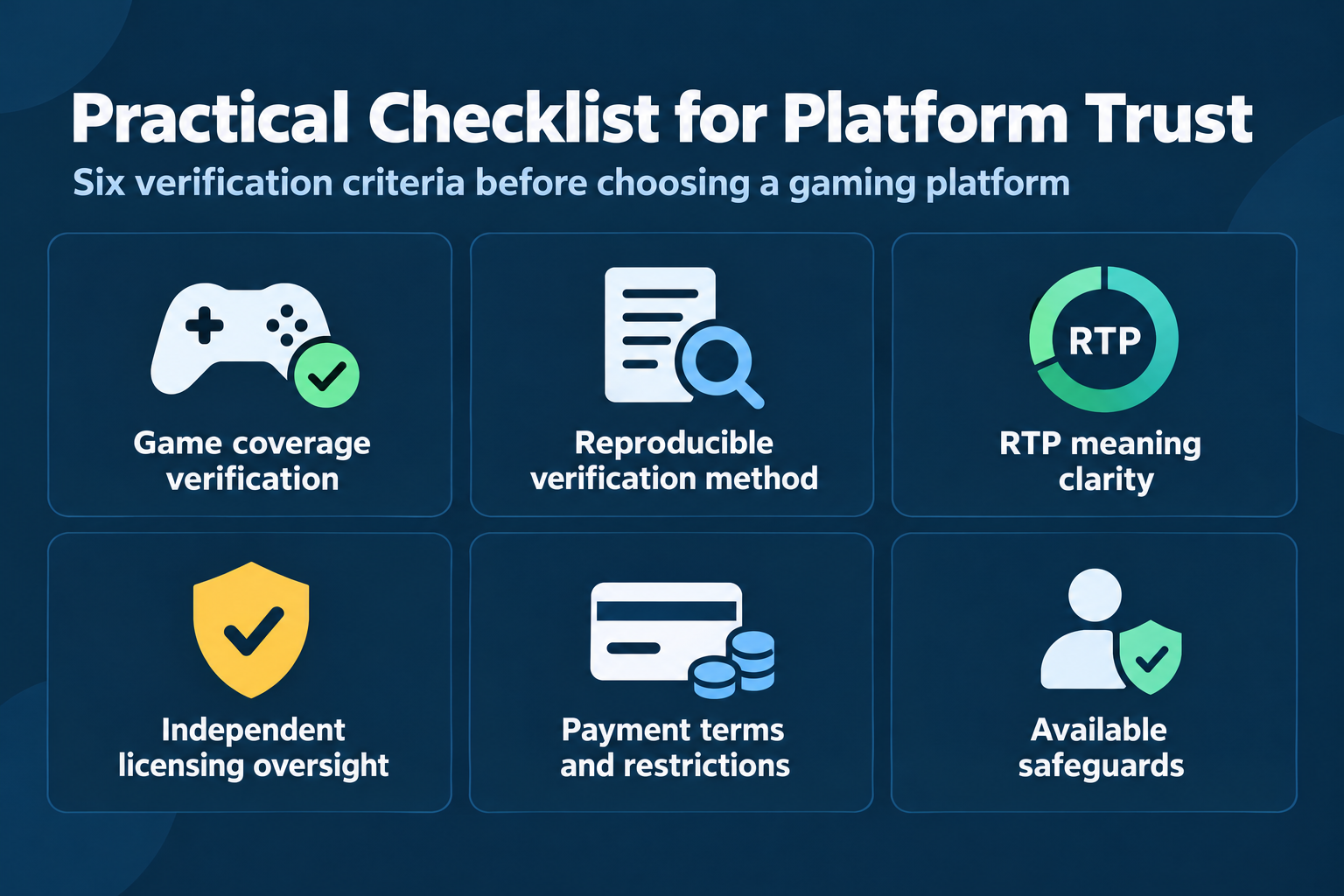
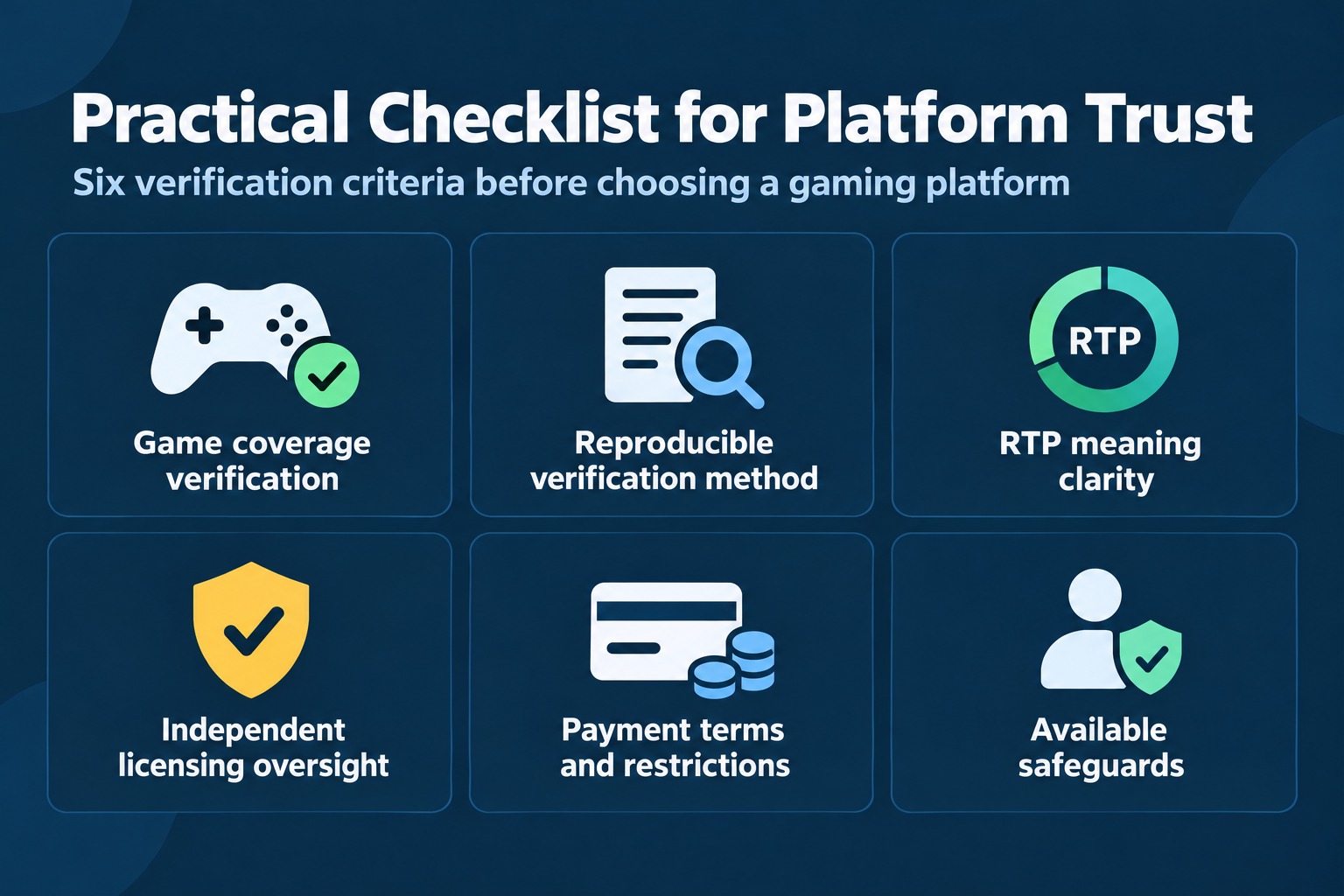
Trust is easier to assess when broad claims are broken into checks a player can perform. Before depositing, the following questions put fairness, value and day-to-day use in their proper places:
- Which results can be checked? Identify the specific games covered by a verification method rather than assuming it applies across the catalogue.
- Is the method usable? Look for accessible seeds or other required inputs, an explanation of when they are disclosed and clear steps for reproducing an outcome.
- What does each RTP figure describe? Read the number for the particular game and remember that a long-run theoretical return is not a session forecast.
- Who oversees the operation? Examine licensing information and any documented independent testing separately from claims about individual game results.
- How do payments work? Check supported assets and networks, withdrawal terms, identity requirements and restrictions that apply in the player’s location.
- What safeguards are available? Review spending and time controls, self-exclusion options and information on responsible gambling before social or promotional features add urgency.
No single answer settles all six questions. A cryptographic check can make a completed outcome easier to inspect; an RTP display can make a game’s stated long-run characteristics easier to compare; independent oversight and usable safeguards address other risks. The strongest form of digital trust comes from knowing exactly what each piece of evidence proves—and refusing to ask it to prove more.